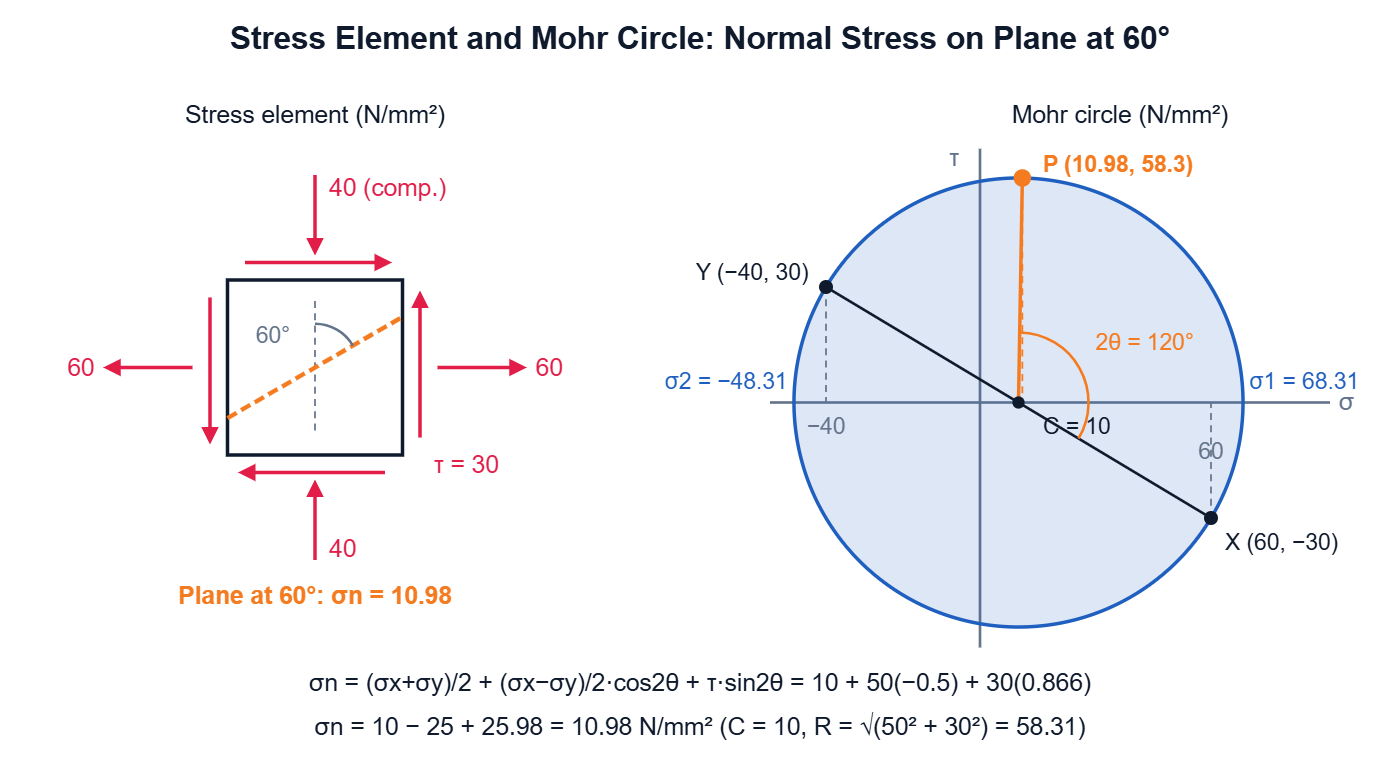
The stresses on two perpendicular planes through a point are 60 N/mm² tension, 40 N/mm² compression and 30 N/mm² shear. What is the absolute normal stress on a plane at 60° to that of the tensile stress?
- A10.98 N/mm²Correct
- B17.63 N/mm²
- C20.98 N/mm²
- D32.63 N/mm²
Solution
Concept
The normal stress on an inclined plane comes from the plane stress transformation equation.
Formula
σn = (σx + σy)/2 + ((σx − σy)/2) cos2θ + τxy sin2θ
Step-by-step solution
1. Take σx = +60 N/mm² (tension), σy = −40 N/mm² (compression), τxy = 30 N/mm². 2. θ = 60°, so 2θ = 120°. cos120° = −0.5 and sin120° = 0.866. 3. (σx + σy)/2 = (60 − 40)/2 = 10. 4. (σx − σy)/2 = (60 + 40)/2 = 50, and 50 × (−0.5) = −25. 5. τ sin2θ = 30 × 0.866 = 25.98. 6. σn = 10 − 25 + 25.98 = 10.98 N/mm².
Explanation
Use the stress transformation formula with θ = 60° measured from the plane of the tensile stress. The average stress is 10, the cos term gives −25 and the shear term gives +25.98. The net normal stress is 10.98 N/mm² (tensile).
Why the other options are wrong
B, C and D do not satisfy the transformation equation for θ = 60°. They come from wrong angles, wrong signs or arithmetic slips.
Shortcut
σn = 10 + 50cos120° + 30sin120° = 10 − 25 + 26 ≈ 11.
Common mistake
Using θ instead of 2θ, or taking compression as positive.
Correct answer: A) 10.98 N/mm²