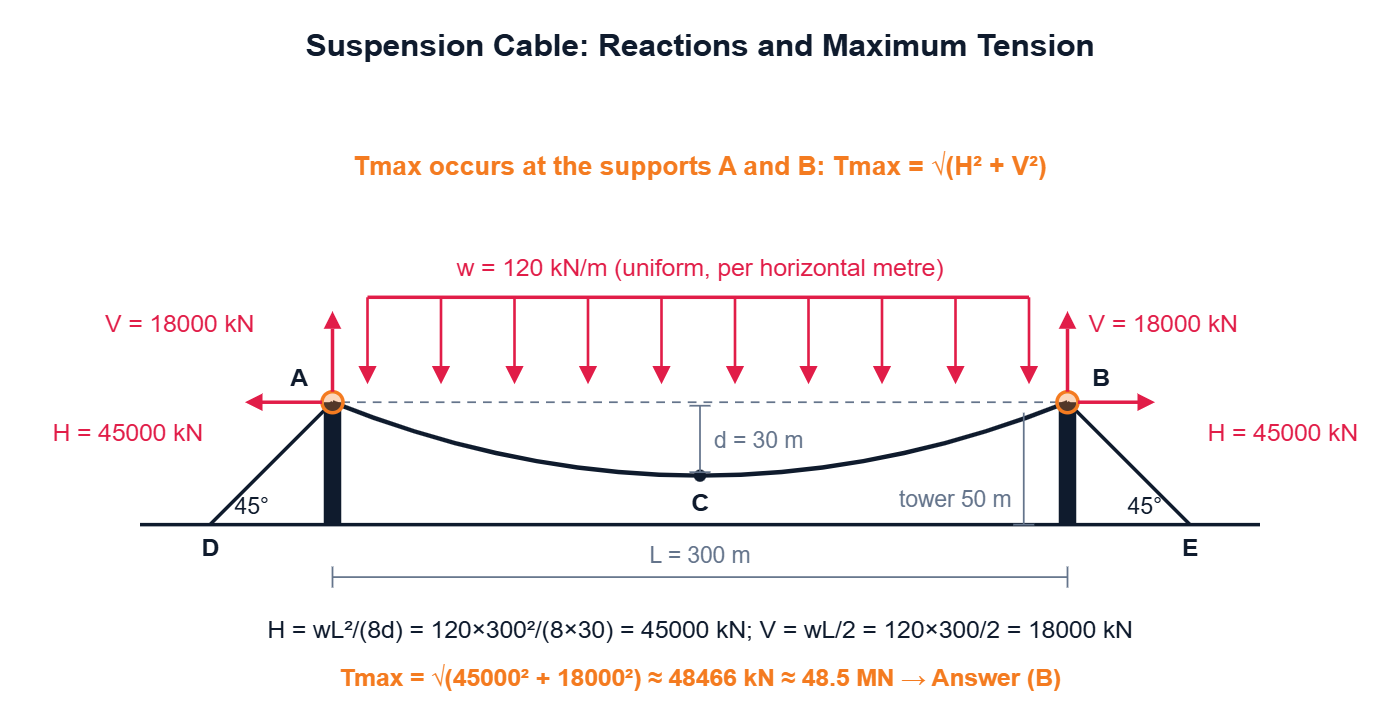
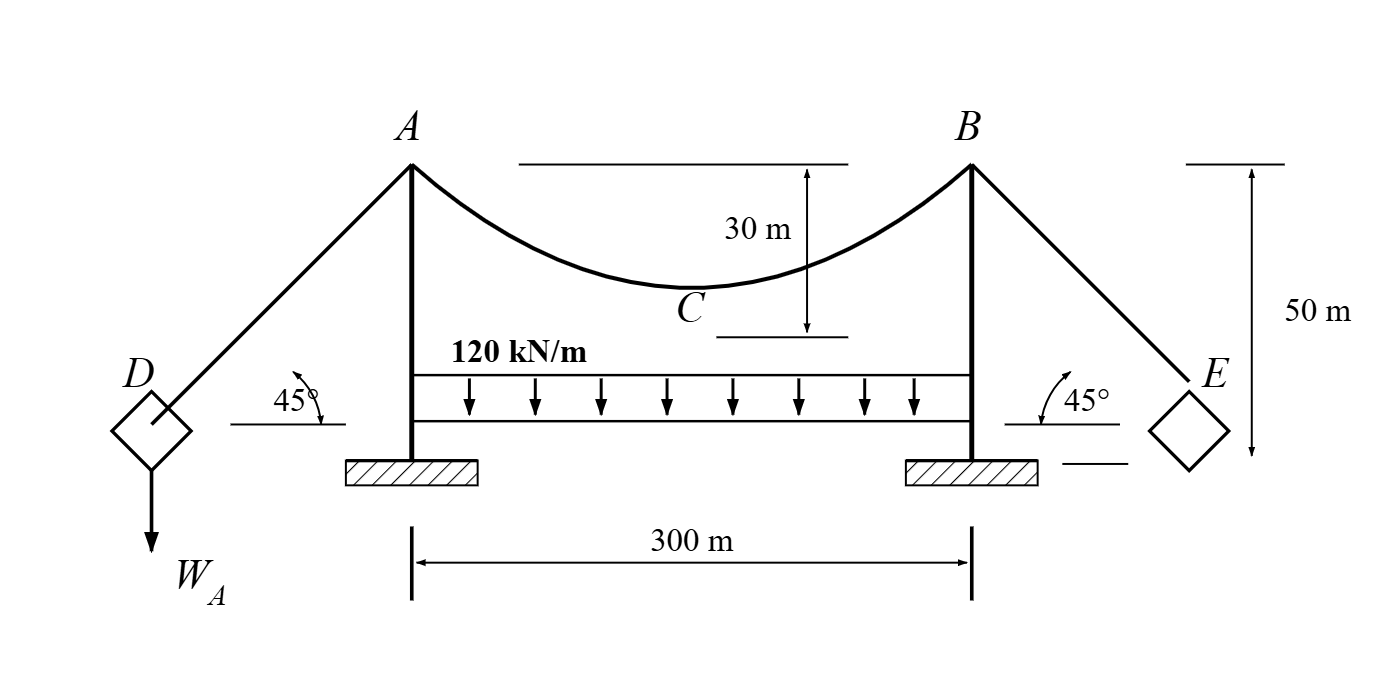
What is the maximum tension (approximately) in the cable as shown in figure [Suspension cable AB of span 300 m, central dip 30 m at C, tower height 50 m, anchor cables AD and BE inclined at 45°], if it carries a uniform horizontally distributed load of intensity 120 kN/m?
- A48.5 kN
- B48.5 MNCorrect
- C485 kN
- D4850 N
Solution
Concept
A cable with a horizontal UDL takes a parabolic shape. Maximum tension occurs at the supports and is found from the horizontal thrust H and the vertical reaction V.
Formula
H = wL2/(8d); V = wL/2; Tmax = √(H2 + V2)
Step-by-step solution
1. Given w = 120 kN/m, L = 300 m, central dip d = 30 m. 2. Horizontal tension H = wL2/(8d) = 120 × 3002/(8 × 30) = 45000 kN. 3. Vertical reaction at each support V = wL/2 = 120 × 300/2 = 18000 kN. 4. Tmax = √(450002 + 180002) = √(2.349 × 10⁹) ≈ 48466 kN. 5. Tmax ≈ 48.5 × 10³ kN = 48.5 MN.
Explanation
Under a uniform horizontal load, the cable becomes a parabola. Tension is highest at the towers, where both the horizontal and vertical components act. Combining H = 45 MN and V = 18 MN gives about 48.5 MN.
Why the other options are wrong
A: 48.5 kN is 1000 times too small. C: 485 kN is 100 times too small. D: 4850 N is far too small. The unit conversion is wrong.
Shortcut
Tmax = (wL/2) × √(1 + (L/(4d))2
Correct answer: B) 48.5 MN