When pipes of different diameters are connected in series from end to end to form a pipe line, the total head loss developed is equal to:
- AZero
- BSum of major head losses in each pipe
- CSum of local head losses only
- DSum of local head losses and major head losses in each pipeCorrect
Solution
Concept
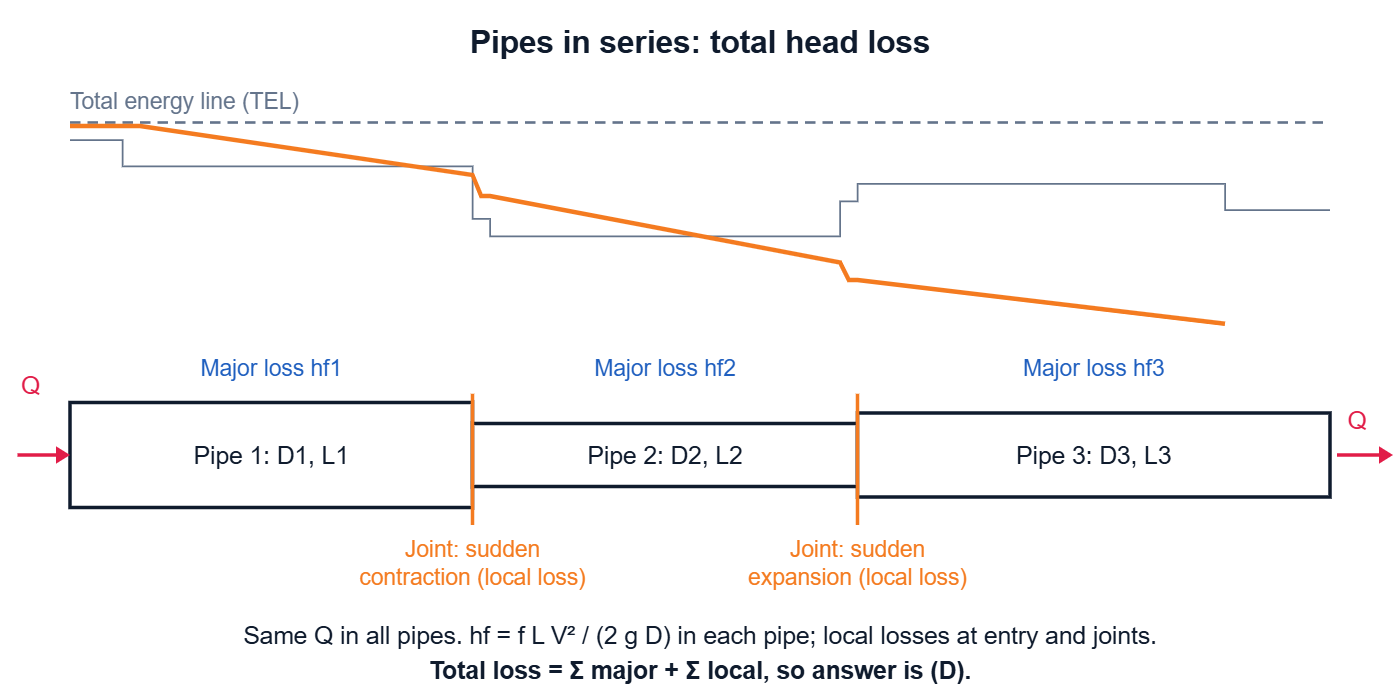
In pipes connected in series, total head loss = sum of friction (major) losses in each pipe + all minor (local) losses.
Formula
H = Σ hf + Σ hm = Σ (f L V2 / (2 g D)) + entry, exit, contraction and expansion losses
Step-by-step solution
1. In series, the same discharge Q flows through each pipe. 2. Each pipe has a friction (major) loss hf = f L V2 / (2 g D). 3. At joints, entry and exit there are local (minor) losses, such as sudden contraction or expansion. 4. Total head loss = sum of all major losses + sum of all minor losses. 5. So the answer is (D).
Explanation
In a series pipeline, the same discharge passes through every pipe, so the losses add up. Each pipe has a friction loss, and every change in diameter, entry and exit causes a local loss. The total head loss is the sum of both types.
Why the other options are wrong
(A) Head loss is never zero in real flow. (B) Ignores local losses at joints, entry and exit. (C) Ignores friction losses, which are usually the largest part.
Shortcut
Series: same Q, losses add. Parallel: same head loss, discharges add.
Common mistake
Taking only friction losses and forgetting minor losses at diameter changes.
Correct answer: D) Sum of local head losses and major head losses in each pipe