Which one of the following statements is correct for flow in open channels?
- AWhen the depth of flow in a channel is greater than the critical depth, the flow is said to be super-critical flow
- BWhen the depth of flow in a channel is equal to critical depth, the flow is said to be super-critical flow
- CWhen the depth of flow in a channel is less than the critical depth, the flow is said to be sub-critical flow
- DWhen the depth of flow in a channel is greater than the critical depth, the flow is said to be sub-critical flowCorrect
Solution
Concept
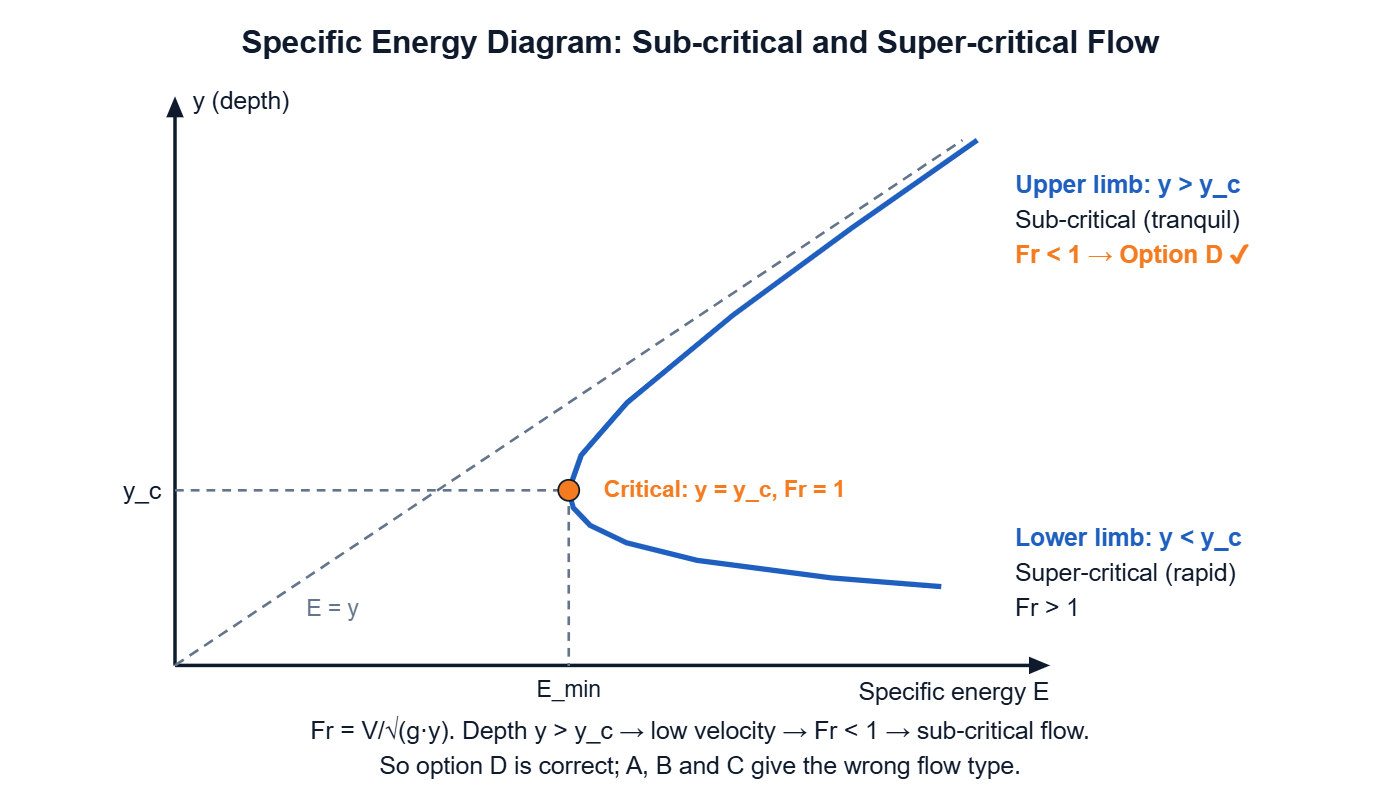
Flow type depends on the actual depth compared with the critical depth (or on the Froude number).
Formula
Fr = V/√(g×D); Fr < 1 sub-critical, Fr = 1 critical, Fr > 1 super-critical
Step-by-step solution
1. Critical depth yc is the depth at which specific energy is minimum (Fr = 1). 2. If y > yc, velocity is low, so Fr < 1 and the flow is sub-critical (tranquil). 3. If y = yc, the flow is critical. 4. If y < yc, velocity is high, so Fr > 1 and the flow is super-critical (rapid). 5. Only option D matches this rule.
Explanation
When depth is more than critical depth, the water moves slowly and Fr < 1, so the flow is sub-critical. When depth is less than critical depth, the flow is fast and super-critical. So statement D is correct.
Why the other options are wrong
A: y > yc gives sub-critical flow, not super-critical. B: y = yc gives critical flow, not super-critical. C: y < yc gives super-critical flow, not sub-critical.
Shortcut
Deep water flows slowly (sub-critical). Shallow water flows fast (super-critical).
Common mistake
Mixing up the two terms and thinking a greater depth means super-critical flow.
Correct answer: D) When the depth of flow in a channel is greater than the critical depth, the flow is said to be sub-critical flow