A Cipolletti weir has length of 2.0 m and head over the weir is 1 m. What is the discharge over the weir? (Take cd = 0.62)
- A10.35 m³/s
- B3.66 m³/sCorrect
- C45.21 m³/s
- D75.68 m³/s
Solution
Concept
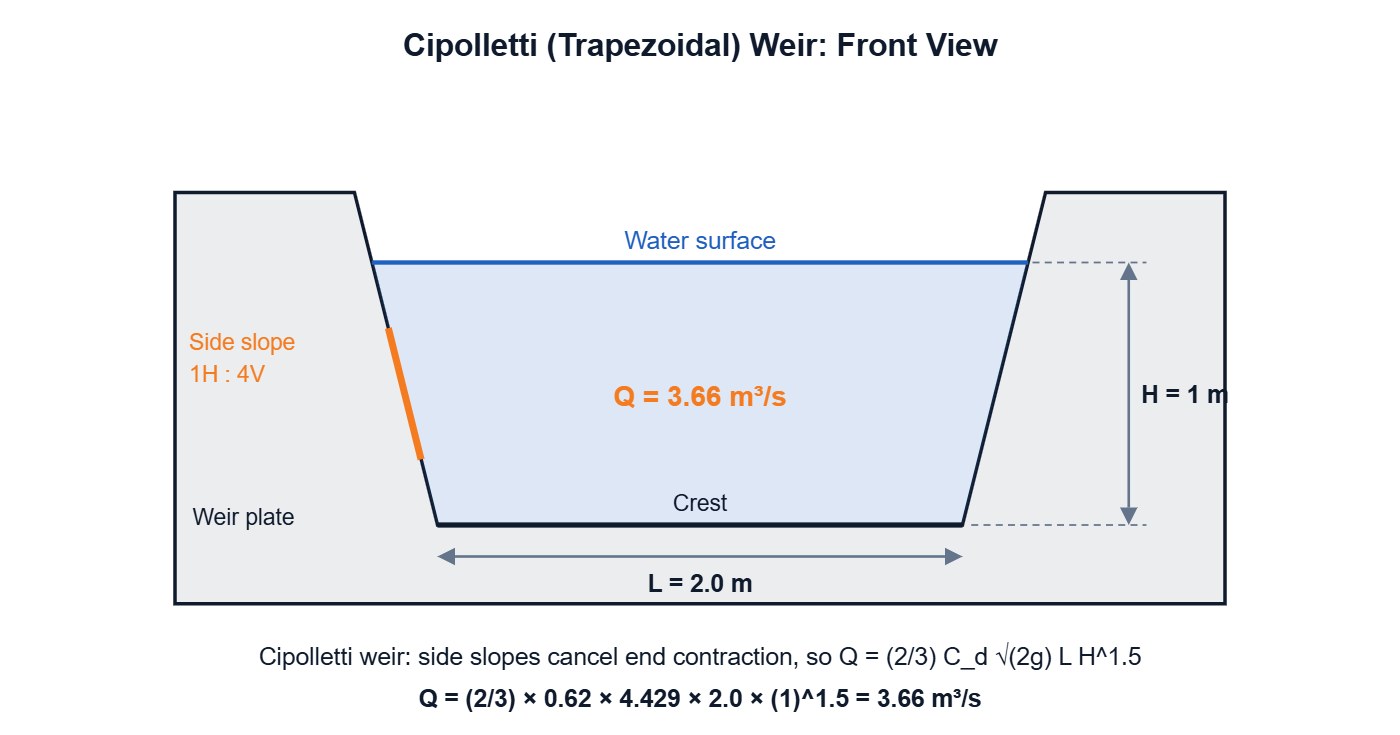
A Cipolletti weir has side slopes of 1H:4V. The extra flow through the sloping sides cancels the loss from end contractions, so it works like a rectangular weir without end contractions.
Formula
Q = (2/3) × Cd × √(2g) × L × H3/2
Step-by-step solution
1. Data: L = 2.0 m, H = 1 m, Cd = 0.62, g = 9.81 m/s² 2. √(2g) = √(19.62) = 4.429 3. H3/2 = 13/2 = 1 4. Q = (2/3) × 0.62 × 4.429 × 2.0 × 1 5. Q = 0.4133 × 4.429 × 2.0 = 3.66 m³/s
Explanation
In a Cipolletti weir, the sloping sides add flow equal to the flow lost by end contractions. So we use the simple rectangular weir formula with full crest length. This gives Q = 3.66 m³/s.
Why the other options are wrong
A (10.35): wrong use of constants or the head term. C (45.21) and D (75.68): far too large for L = 2 m and H = 1 m.
Shortcut
(2/3) × Cd × √(2g) = 1.83 for Cd = 0.62, so Q = 1.83 × L × H3/2 = 1.83 × 2 = 3.66 m³/s
Common mistake
Applying the end-contraction correction (L - 0.2H). This is not needed for a Cipolletti weir.
Correct answer: B) 3.66 m³/s