Without velocity of approach, the discharge through a Cipolletti weir is :
- AQ = (2/3) Cd L √(2g) H3/2Correct
- BQ = (1/2) Cd L √(5g) H2/3
- CQ = (2/3) Cd L √g H2/3
- DQ = (1/2) Cd L √(5g) H3/2
Solution
Concept
Discharge over a Cipolletti (trapezoidal) weir
Formula
Q = (2/3) Cd L √(2g) H3/2
Step-by-step solution
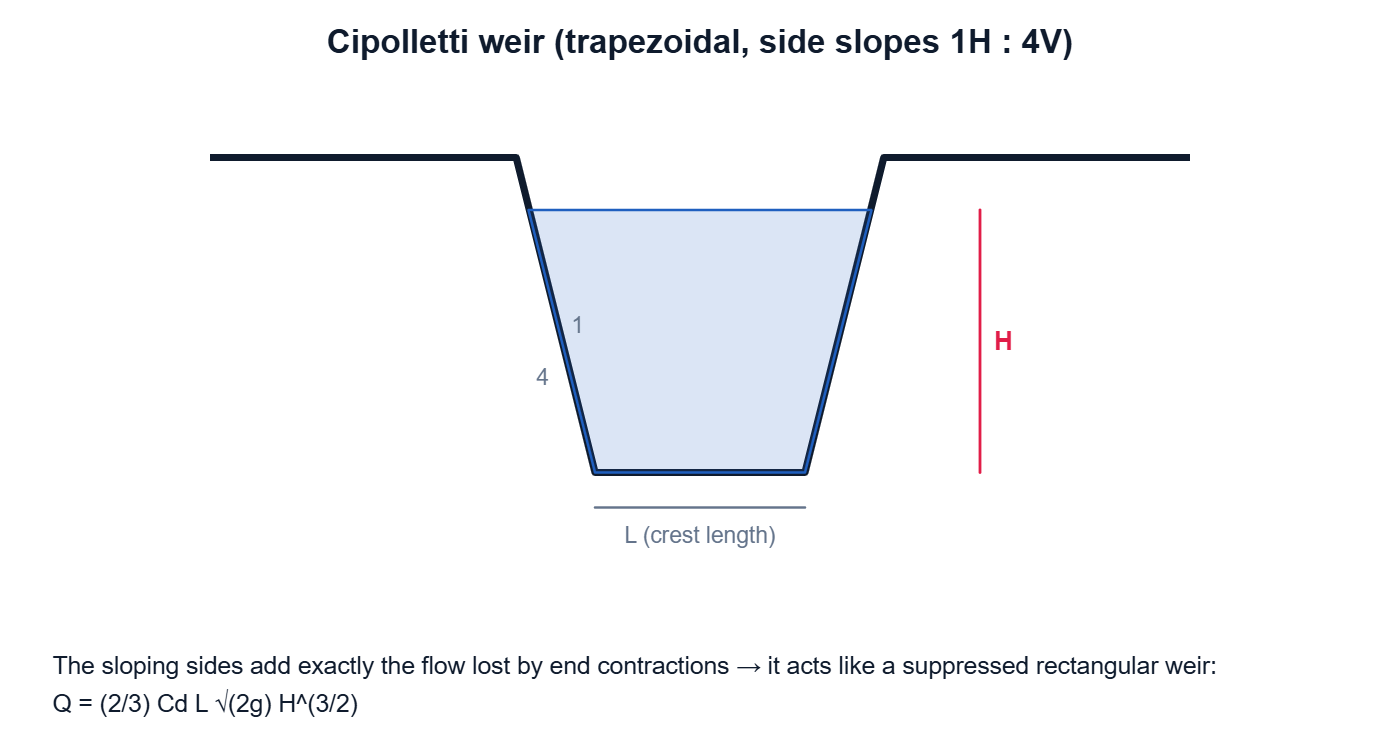
1. A Cipolletti weir is a trapezoidal weir with side slopes 1 horizontal : 4 vertical. 2. The extra discharge through the sloping sides compensates for the end contractions of a rectangular weir. 3. So the discharge equals that of a suppressed rectangular weir: Q = (2/3) Cd L √(2g) H3/2.
Explanation
The side slope of 1:4 is chosen so that the additional flow through the triangular ends exactly offsets the reduction due to end contractions. Hence the contraction correction (0.1 n H) is not needed.
Why the other options are wrong
Options with H2/3 have the wrong exponent, and √(5g) forms are not the weir formula.
Shortcut
Cipolletti: Q = 1.86 L H3/2 (approx.).
Common mistake
Using H2/3.
Correct answer: A) Q = (2/3) C_d L √(2g) H^(3/2)