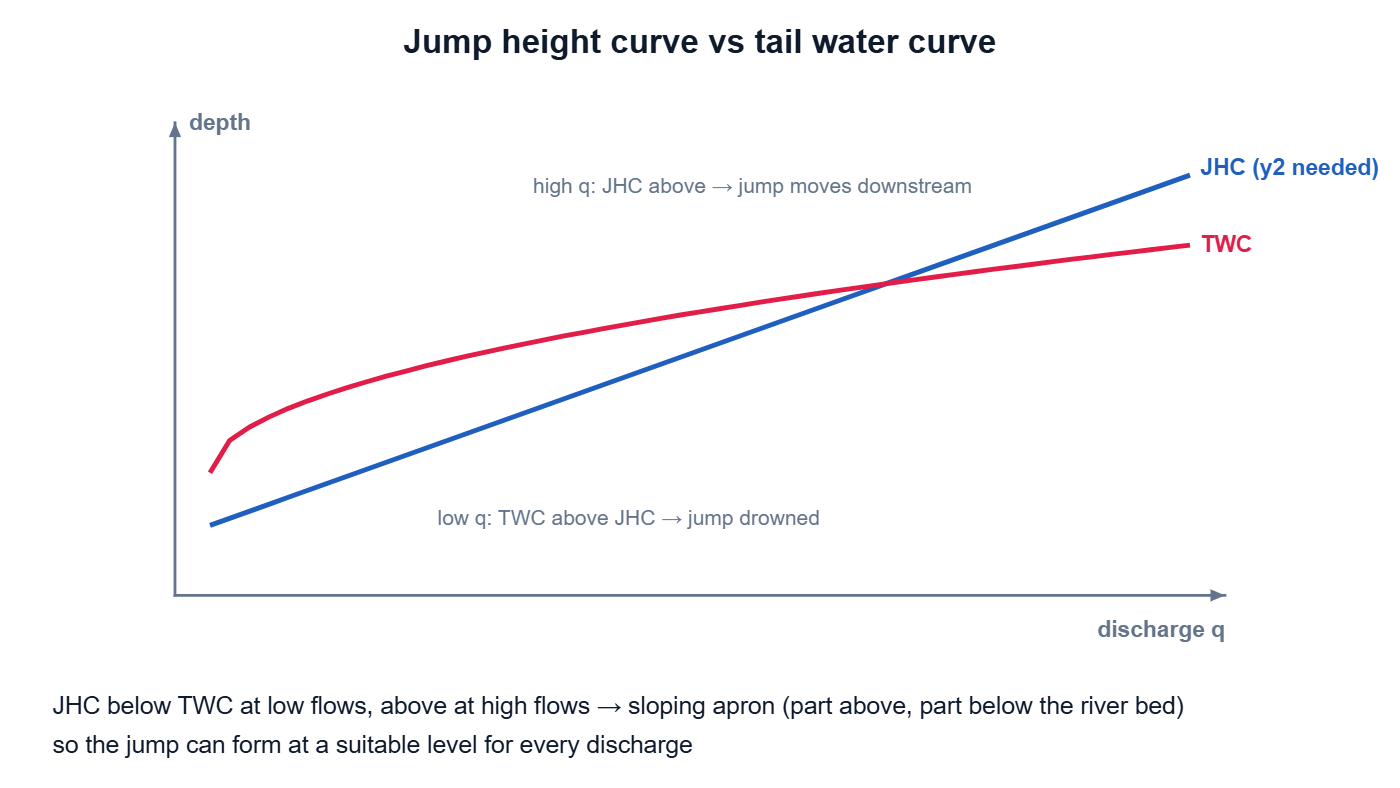
At the foot of a spillway, the jump rating curve is below the tail water curve at low flows and above it at high flows. The suitable type of energy dissipater for this situation is
- AA ski-jump bucket
- BA horizontal apron
- CA sloping apronCorrect
- DA stilling pool
Solution
Concept
Sloping Apron Energy Dissipater
Formula
N/A
Step-by-step solution
1. Read the question regarding the suitable energy dissipater when the jump rating curve lies below the tailwater curve at low flows and above it at high flows. 2. Recall that a sloping apron accommodates varying tailwater levels by allowing the hydraulic jump to form at different elevations along the slope. 3. Select Option C as the correct choice.
Explanation
A sloping apron is suitable for this condition because its varying floor level handles both flow rates. At low flows, the jump forms on the higher part of the slope to prevent it from being drowned by the deep tailwater, while at high flows, the jump forms on the lower part of the slope where there is sufficient depth for it to form properly.
Shortcut
To remember when to use a Sloping Apron, use the rule "Crossing Curves = Sloping Apron": - Changing Water Levels: When the jump rating curve crosses the tailwater curve (below at low flows, above at high flows), depth requirements change with flow rate. - Sloping Floor: A sloping apron provides a continuous range of floor elevations so the hydraulic jump can adjust to both low and high tailwater depths.
Common mistake
A common mistake is selecting option B (a horizontal apron) by assuming a simple flat apron can handle variable tailwater conditions, ignoring that horizontal aprons require the tailwater depth to closely match the hydraulic jump depth across all discharges. Another frequent error is selecting option A (a ski-jump bucket) by confusing situations where tailwater is significantly lower than required with cases where the jump rating curve crosses the tailwater rating curve.
Correct answer: C) A sloping apron