What should be done to dissipate the residual energy, if the tail water deficiency is small?
- AConstruction of baffle wallCorrect
- BSloping apron
- CStilling basin
- DSki jump bucket
Solution
Concept
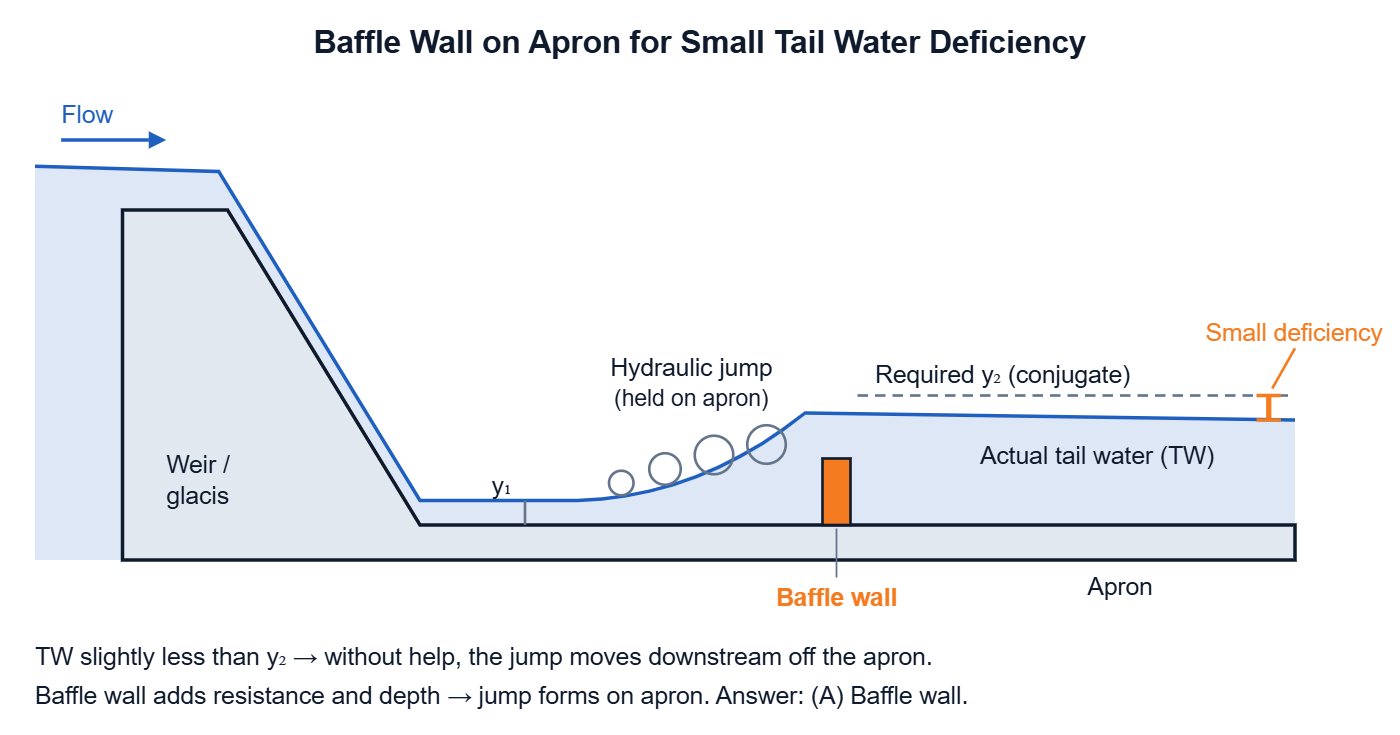
When the tail water depth is only slightly less than the required jump depth, a baffle wall can raise the water level and form the jump.
Formula
y2/y1 = 0.5 × [√(1 + 8 F12) - 1]
Step-by-step solution
1. A hydraulic jump forms when the tail water depth equals the conjugate depth y2. 2. If the tail water is less than y2, we have a tail water deficiency and the jump moves downstream. 3. If the deficiency is small, a baffle wall on the apron creates extra depth and resistance, so the jump forms on the apron. 4. If the deficiency is large, we need a depressed stilling basin, a sloping apron or a ski jump bucket. 5. So for a small deficiency, construct a baffle wall.
Explanation
A small shortage of tail water can be fixed by a simple baffle wall. The wall raises the water level upstream of it and forces the jump to form on the apron. Bigger shortages need bigger works, such as a stilling basin or a ski jump.
Why the other options are wrong
B: A sloping apron is used when the deficiency changes with discharge. C: A depressed stilling basin is used when the deficiency is large. D: A ski jump bucket is used when the tail water is very low, so a jump cannot form at all.
Shortcut
Small deficiency means a baffle wall. Large deficiency means a stilling basin or ski jump.
Common mistake
Choosing a stilling basin for every deficiency case without checking how large the deficiency is.
Correct answer: A) Construction of baffle wall