In which one of the following types of falls, the energy dissipation on a straight glacis remain incomplete due to vertical component of velocity remaining unaffected?
- AMontague type fallsCorrect
- BGravity falls
- CInglis falls
- DBaffle falls
Solution
Concept
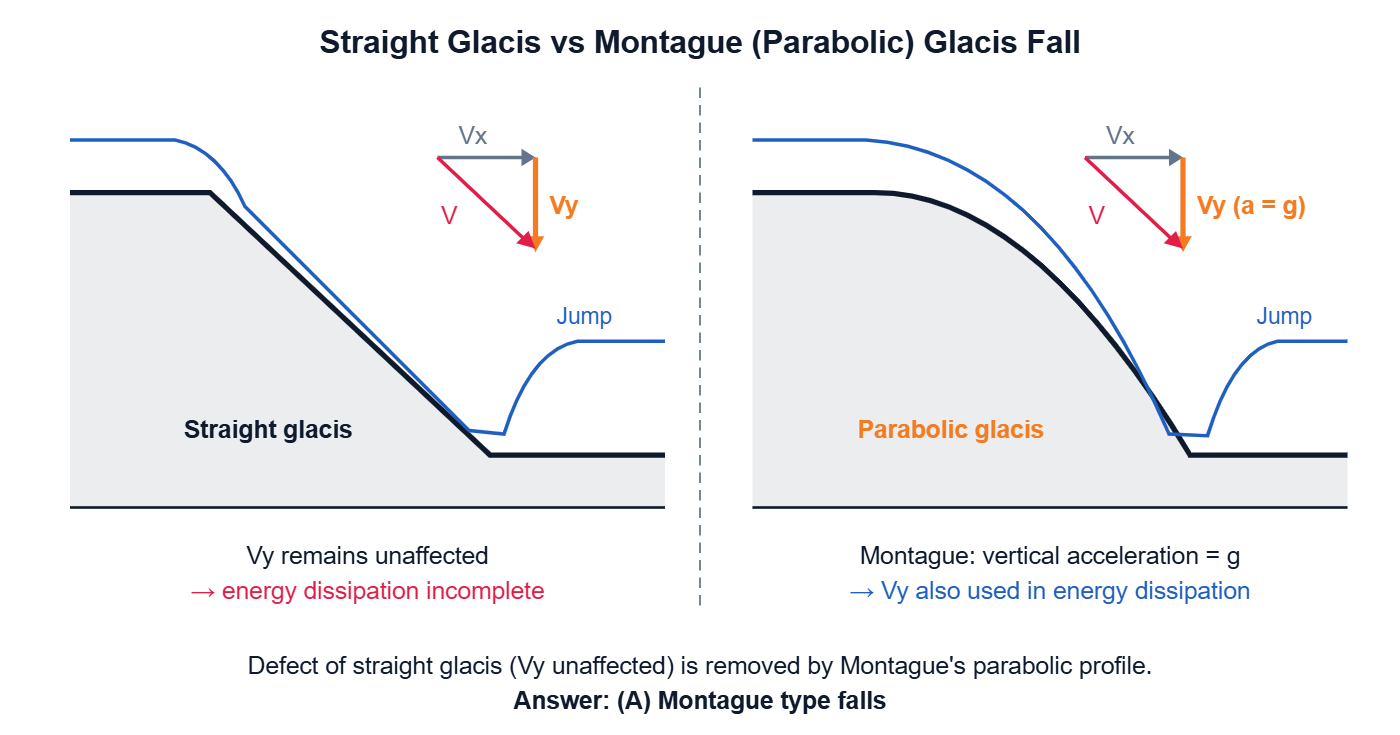
On a straight glacis, only the horizontal velocity is used in the jump and the vertical component is not destroyed. Montague's parabolic glacis fall was developed to solve this problem.
Step-by-step solution
1. In a glacis fall, water flows down a slope and forms a hydraulic jump at the toe to dissipate energy. 2. On a straight glacis, the vertical component of velocity remains unaffected, so energy dissipation is incomplete. 3. Montague studied this problem and proposed a parabolic glacis profile. 4. The parabolic glacis keeps the vertical acceleration equal to g, so the vertical component is also used for energy dissipation. 5. This defect and its remedy are described under Montague type falls in textbooks, so the answer is (A).
Explanation
On a straight glacis, the vertical part of the velocity is not destroyed, so some energy is not dissipated. Montague found this problem and gave a parabolic glacis to correct it. So this statement is linked with Montague type falls.
Why the other options are wrong
B: Gravity falls is a general term, not linked to this specific defect. C: Inglis fall uses a straight glacis with a baffle wall; it is not the fall described by this statement in standard texts. D: Baffle falls dissipate energy with a baffle wall; the vertical velocity defect is not their defining point.
Shortcut
Vertical velocity problem on a straight glacis, parabolic glacis remedy: think Montague.
Common mistake
Choosing Inglis fall just because it has a straight glacis, without linking the statement to Montague's study.
Correct answer: A) Montague type falls