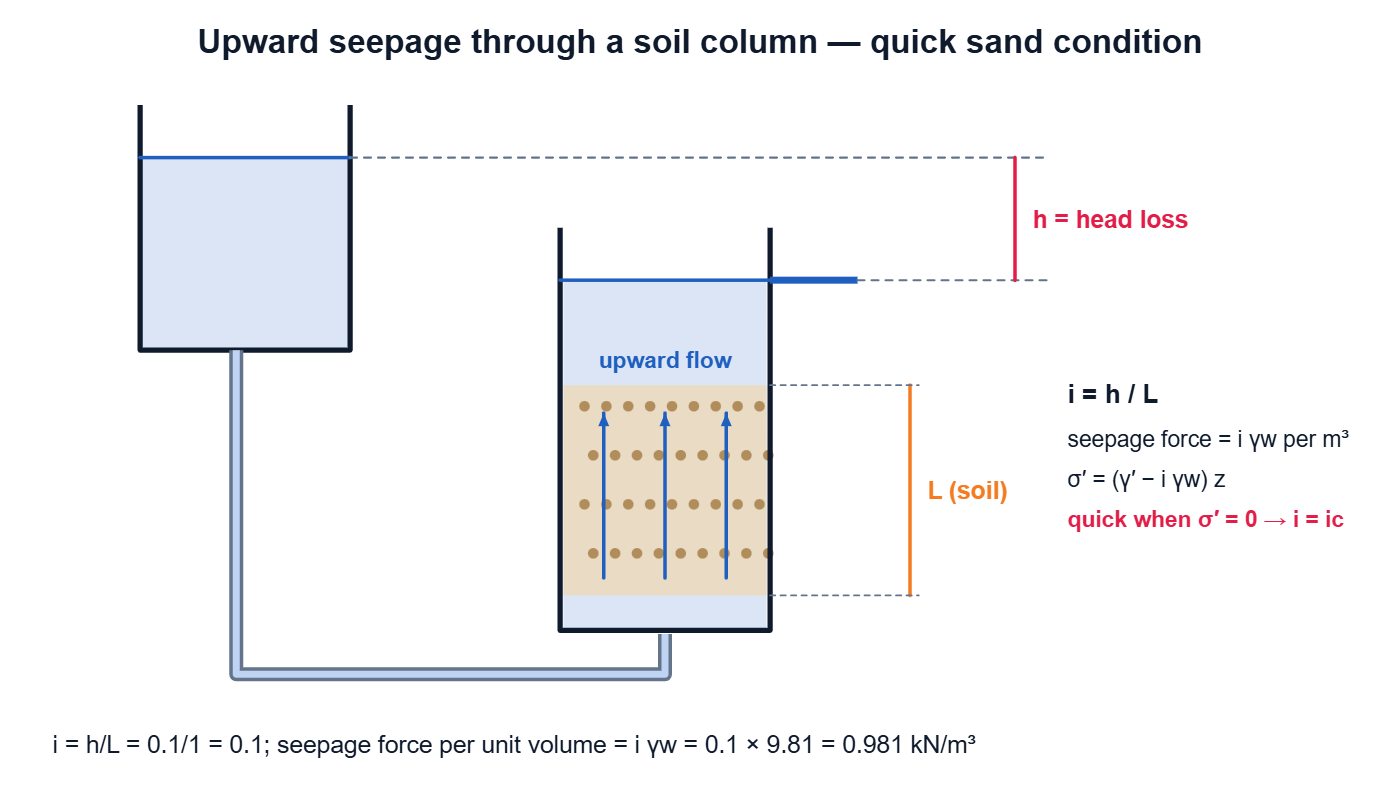
If 0.1 m head loss takes place while water flows in upward direction through 1 m of the soil layer, then the seepage force per volume is
- A9.81 kN/m³
- B0.981 kN/m³Correct
- C98.1 kN/m³
- DNone of these
Solution
Concept
Seepage Force per Unit Volume
Formula
Seepage force per unit volume (j) = i × γw, where i = h / L (Hydraulic Gradient = Head Loss / Soil Length) and γw = Unit Weight of Water.
Step-by-step solution
1. Calculate the hydraulic gradient: i = h / L = 0.1 m / 1 m = 0.1 2. Multiply by the unit weight of water (γw = 9.81 kN/m³): j = 0.1 × 9.81 = 0.981 kN/m³
Explanation
Seepage force per unit volume is calculated using the formula: Seepage Force per Volume = Hydraulic Gradient (i) × Unit Weight of Water (γw). Here, the hydraulic gradient (i) is head loss divided by soil length, which is 0.1 m / 1 m = 0.1. Multiplying the hydraulic gradient (0.1) by the unit weight of water (9.81 kN/m³) gives 0.981 kN/m³, which matches option B.
Shortcut
Multiply the hydraulic gradient (head loss divided by soil length) directly by 9.81. For a gradient of 0.1, simply shift the decimal point of 9.81 one place to the left to get 0.981.
Common mistake
A common mistake is forgetting to multiply the hydraulic gradient (i = 0.1) by the unit weight of water (9.81 kN/m³) and incorrectly selecting Option A (9.81 kN/m³) by assuming seepage force per unit volume is equal to the unit weight of water itself.
Correct answer: B) 0.981 kN/m³