In Earthen Embankments, a Phreatic Line is defined as
- AThe line representing the top-most flow line where the pressure is atmospheric.Correct
- BThe line connecting all points of equal pore water pressure.
- CThe boundary between the clay core and the rock toe.
- DThe line indicating the maximum depth of excavation.
Solution
Concept
Phreatic Line in Earthen Dams
Formula
N/A
Step-by-step solution
1. Identify the definition of a phreatic line in earthen dam hydraulics. 2. Recall that it represents the topmost seepage line where water pressure equals atmospheric pressure. 3. Select Option A as the correct choice.
Explanation
The phreatic line is the highest line through which water flows inside an earthen dam. Along this line, the water pressure is equal to atmospheric pressure, dividing the fully saturated soil below from the unsaturated soil above.
Shortcut
To remember the Phreatic Line, use the key phrase "Top Flow & Atmospheric Pressure": - Top Flow: It is the topmost (highest) seepage flow line inside an earthen dam. - Atmospheric Pressure: The water pressure along this line is strictly equal to atmospheric pressure (zero gauge pressure).
Common mistake
A common mistake is selecting Option B by confusing the phreatic line with an equipotential or equipressure line, assuming it connects points of equal pore pressure throughout the embankment. In reality, while pore water pressure along the phreatic line is everywhere equal to atmospheric pressure (zero gauge pressure), it specifically defines the topmost seepage boundary dividing saturated soil below from unsaturated soil above.
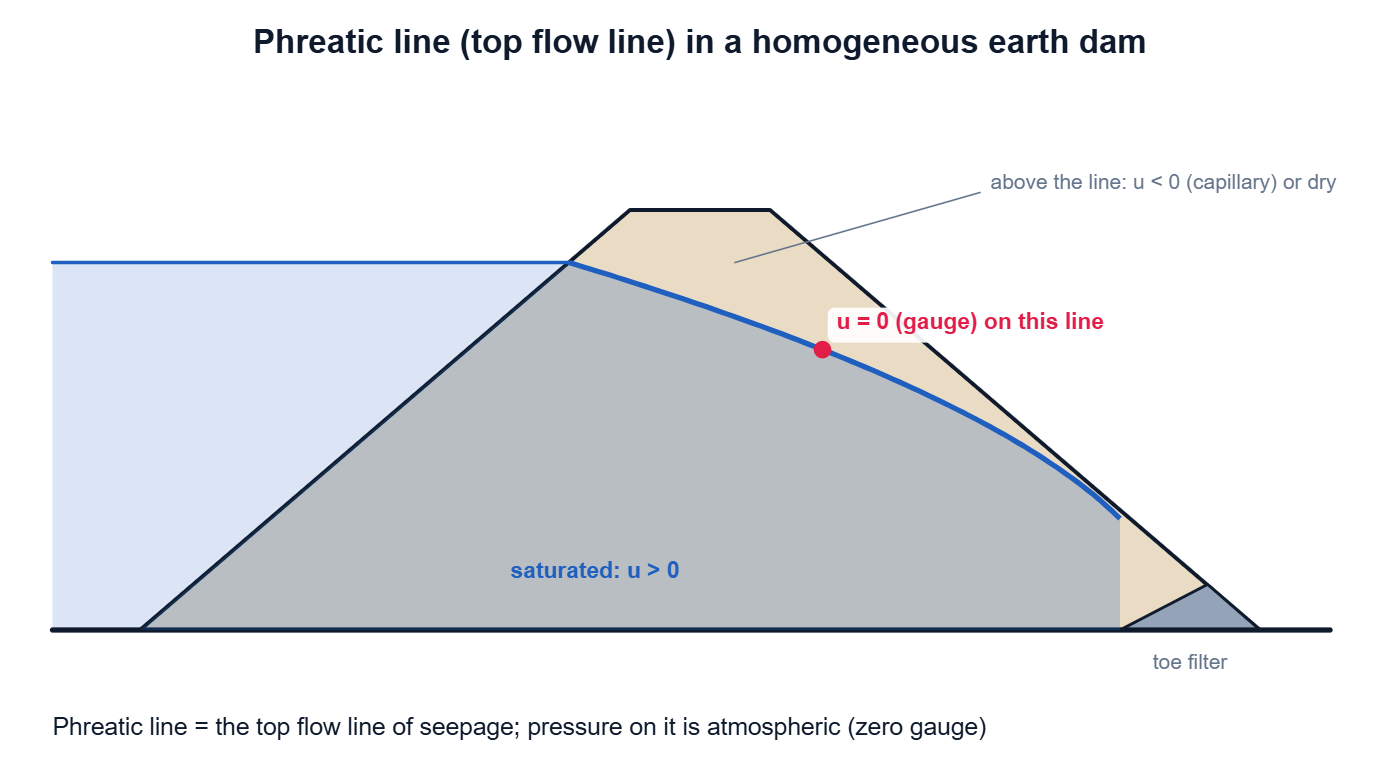
Correct answer: A) The line representing the top-most flow line where the pressure is atmospheric.