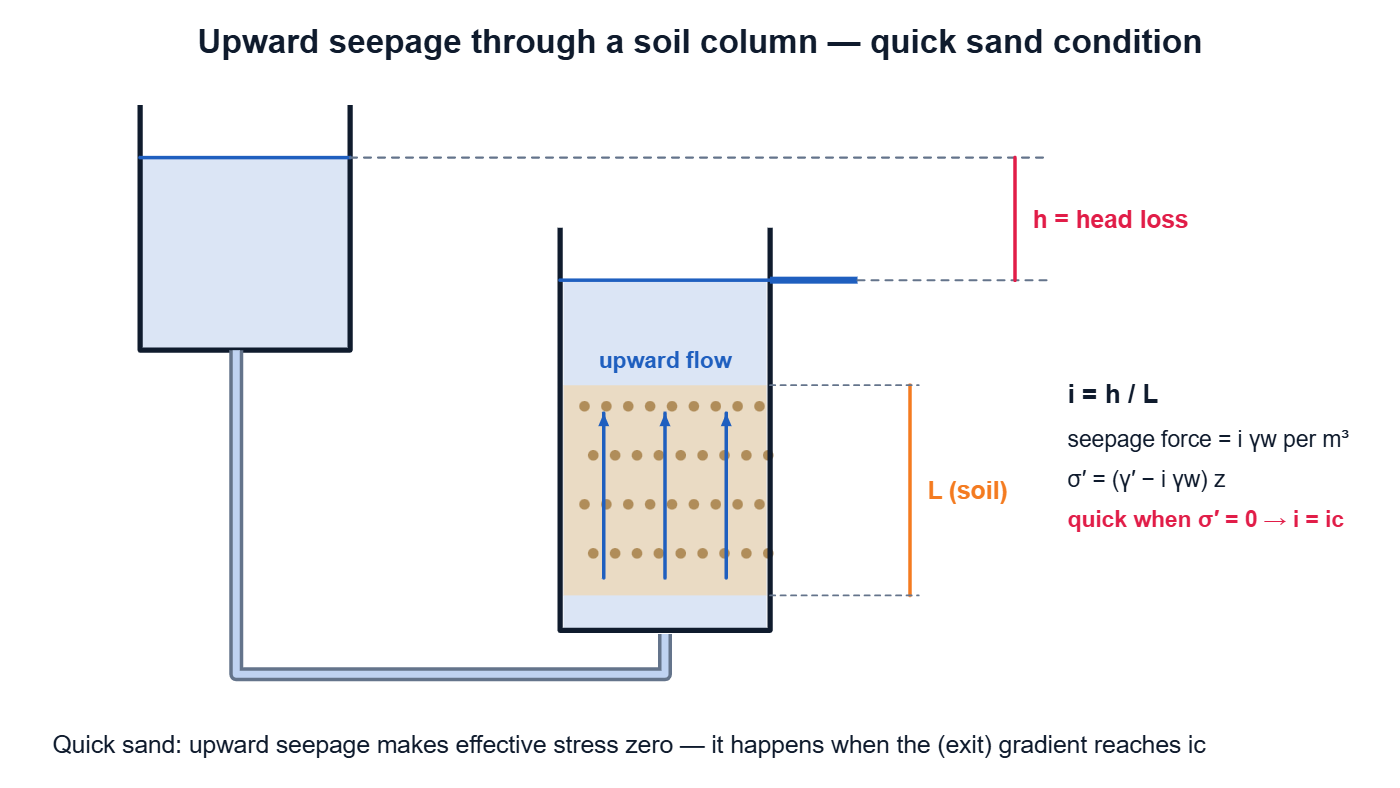
Quick Sand condition occurs in a soil mass when
- AThe exit gradient becomes equal to the critical hydraulic gradient.Correct
- BThe cohesion of the soil becomes infinite.
- CThe effective stress becomes equal to the total stress.
- DThe flow is downward with very high velocity.
Solution
Concept
Quick Sand Condition
Formula
ic = (Gs - 1) / (1 + e) = γsub / γw
Step-by-step solution
1. Review the question regarding the condition under which Quick Sand condition occurs in a soil mass. 2. Recall that the quicksand condition takes place when upward seepage pressure balances the submerged weight of the soil, causing effective stress to become zero and the exit gradient to reach the critical hydraulic gradient (i\_c). 3. Compare the condition with the given options and select Option (a) as the correct choice.
Explanation
Option A is correct because quicksand condition occurs when upward water flow creates a hydraulic gradient that reaches the critical hydraulic gradient. At this stage, the upward pressure of water fully balances the downward weight of the soil particles, reducing the effective stress and shear strength of the soil to zero.
Shortcut
To easily remember the Quick Sand Condition, use the phrase "Upward Flow, Zero Stress, Critical Gradient": - Upward Flow: Water flows upward, balancing the soil weight. - Zero Stress: Effective stress drops to zero, causing a total loss of shear strength. - Critical Gradient: Exit gradient reaches the critical hydraulic gradient (i = ic).
Common mistake
A common mistake is selecting option C by confusing effective stress becoming zero with effective stress becoming equal to total stress. In quicksand conditions, upward seepage pressure equals total stress, reducing effective stress to zero. Another common mistake is selecting option D by incorrectly assuming the flow is downward rather than upward.
Correct answer: A) The exit gradient becomes equal to the critical hydraulic gradient.