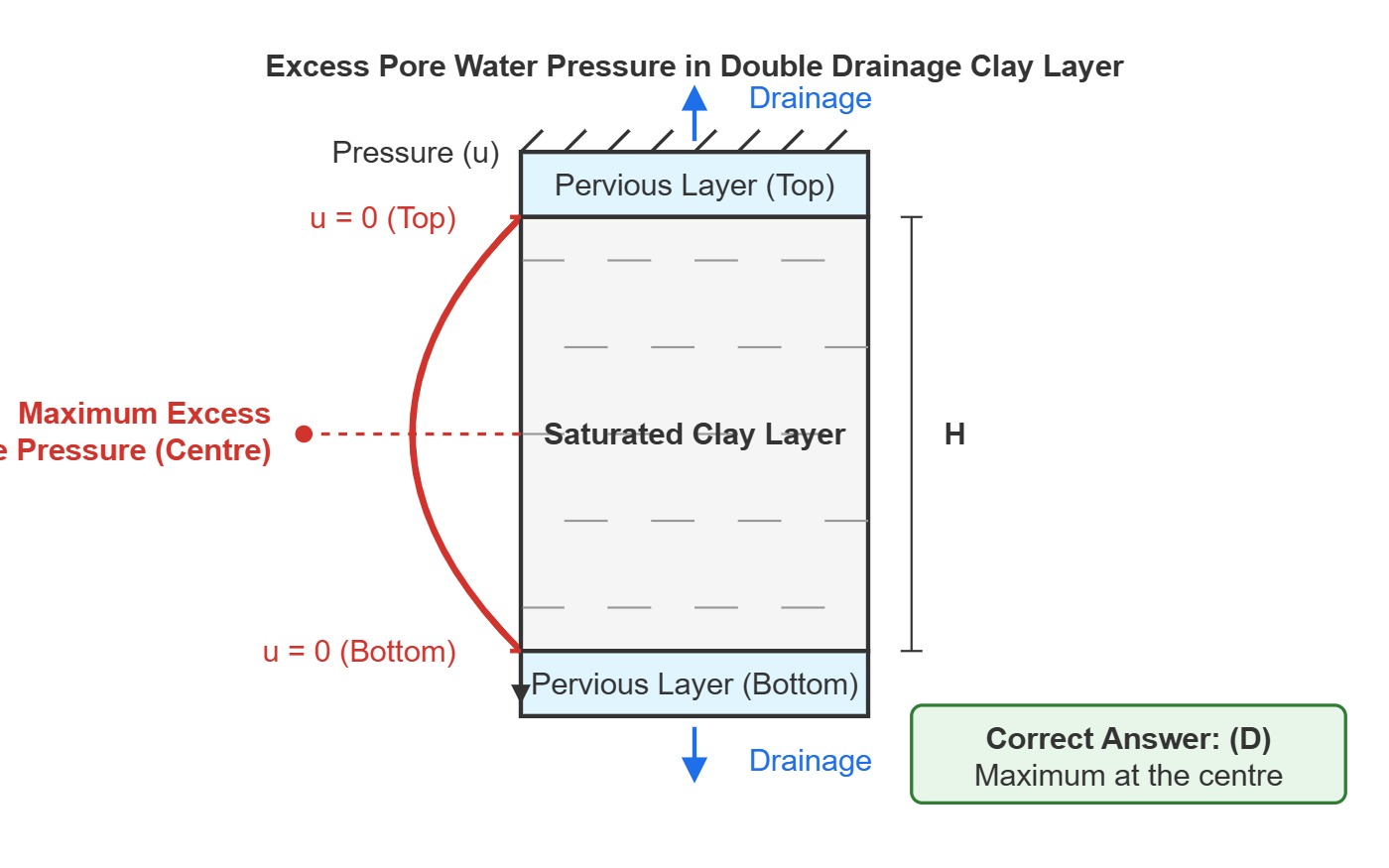
In a saturated clay layer (double drainage), excess pore water is
- AMinimum at the centre
- BMaximum at the top
- CMaximum at the bottom
- DMaximum at the centreCorrect
Solution
Concept
Excess pore water pressure distribution during consolidation varies parabolically across a clay layer, being zero at free draining boundaries and maximum at the mid-depth (center) for a doubly drained layer.
Step-by-step solution
1. Identify the drainage condition: The clay layer has double drainage, meaning water can drain from both the top and bottom surfaces. 2. Understand pore pressure dissipation: Pore water pressure must be fully dissipated (equal to zero) at the pervious boundaries (top and bottom). 3. Analyze distribution shape: The initial excess pore water pressure is uniform, but as consolidation proceeds, the dissipation is slowest at the farthest point from any drainage face, which is the center of the layer. 4. Conclusion: Therefore, the excess pore water pressure remains highest at the centre of a doubly drained clay layer.
Explanation
During consolidation of a saturated clay layer with double drainage (pervious layers at both top and bottom), the excess pore water pressure is maximum at the impermeable or central boundary where the drainage path is the longest, and it is zero at the pervious boundaries (top and bottom) where drainage occurs instantaneously.
Why the other options are wrong
A: Minimum excess pore water pressure occurs at the pervious boundaries (top and bottom), not the centre. B: Top boundary is a drainage face where excess pore water pressure is zero. C: Bottom boundary is also a drainage face where excess pore water pressure is zero.
Shortcut
For single drainage, maximum excess pore pressure is at the impermeable boundary (bottom); for double drainage, it is always at the center.
Common mistake
Confusing total pore pressure with excess pore water pressure, or mixing up single and double drainage boundary conditions.
Correct answer: D) Maximum at the centre