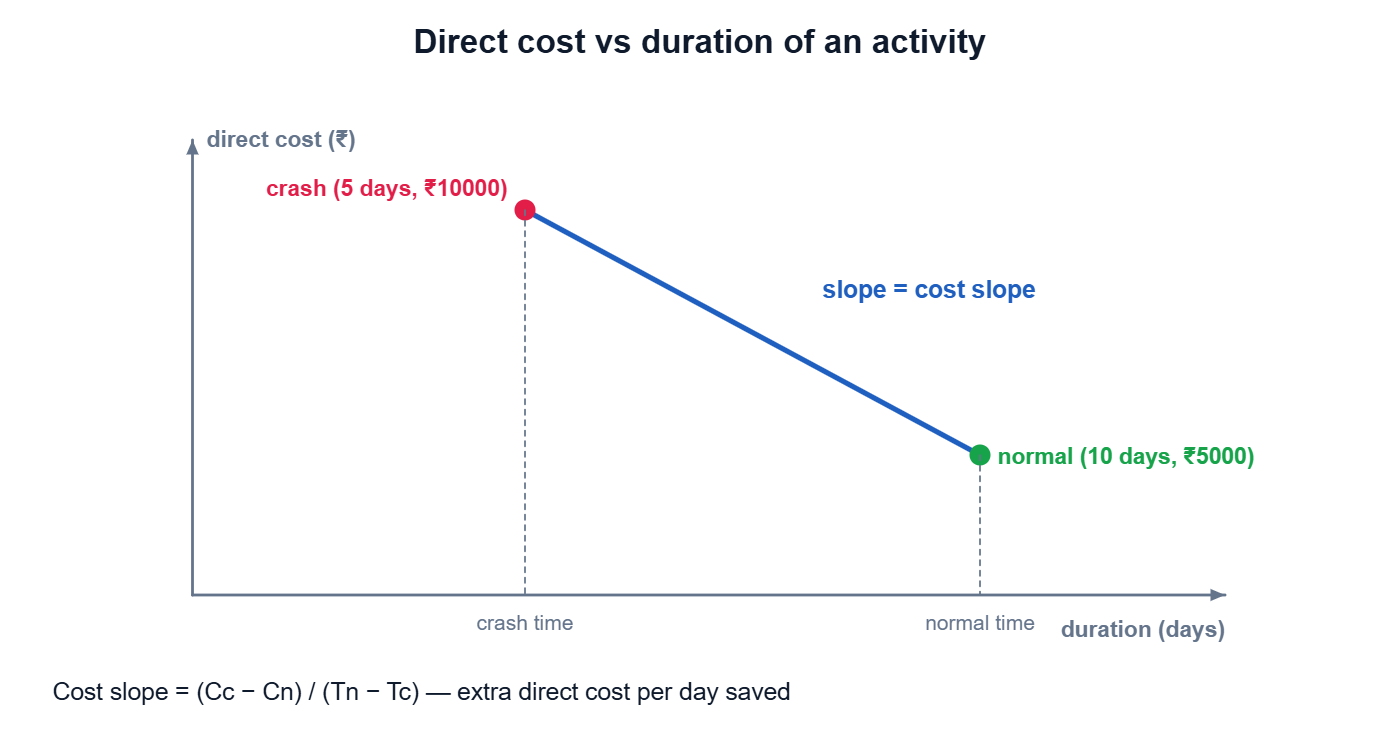
The cost slope of the direct cost curve is given by
- A(Crash cost − normal cost)/(crash time − normal time)
- B(Normal time − crash time)/(crash cost − normal cost)
- C(Crash cost − normal cost)/(normal time − crash time)Correct
- D(Normal cost − crash cost)/(normal time − crash time)
Solution
Concept
Calculation of cost slope in project management
Formula
NONE
Step-by-step solution
1. Direct cost of an activity increases when the duration is reduced from normal time to crash time. Answer: C
Explanation
Cost slope represents the extra direct cost incurred per unit reduction in time for an activity. It is calculated by dividing the increase in cost, which is crash cost minus normal cost, by the saved duration, which is normal time minus crash time. Hence, option C provides the correct formula for the cost slope of a direct cost curve.
Why the other options are wrong
A) The denominator incorrectly subtracts normal time from crash time instead of normal time minus crash time. D) The numerator incorrectly subtracts crash cost from normal cost.
Shortcut
Cost Slope = ΔCost / ΔTime = (Crash Cost - Normal Cost) / (Normal Time - Crash Time).
Common mistake
Selecting option A by incorrectly placing crash time before normal time in the denominator calculation.
Correct answer: C) (Crash cost − normal cost)/(normal time − crash time)