The direction of the steepest slope on a contour is
- AAlong the contour
- BAt an angle of 45° to the contour
- CAt right angles to the contourCorrect
- DAt an angle of 60° to the contour
Solution
Concept
Characteristics of Contour Lines
Formula
N/A
Step-by-step solution
1. Understand that contour lines join points of equal elevation, so slope along a contour line is zero. 2. Recall that the direction of maximum slope (steepest path) is perpendicular to the contour line. 3. Select Option C (At right angles to the contour).
Explanation
Contour lines connect points that are at the exact same elevation, so moving along a contour line results in no change in height (zero slope). To go uphill or downhill as steeply as possible, you must move straight across the contour lines rather than along them, which forms a 90-degree angle (a right angle) to the lines.
Shortcut
To remember the direction of the steepest slope on a contour, use the rule "Steepest = Right Angle": - Moving along a contour line means zero slope (same elevation). - Moving straight across at a 90-degree angle (perpendicular/right angle) gives the shortest path between lines, which means the steepest slope (maximum gradient).
Common mistake
A common mistake is selecting option A by confusing the path along a contour line with the direction of maximum slope. In reality, moving along a contour line results in zero slope since all points on it are at the same elevation, whereas the steepest path (maximum gradient) always occurs perpendicular, or at right angles, to the contour line. Another mistake is choosing option B (45°) by guessing standard geometric angles.
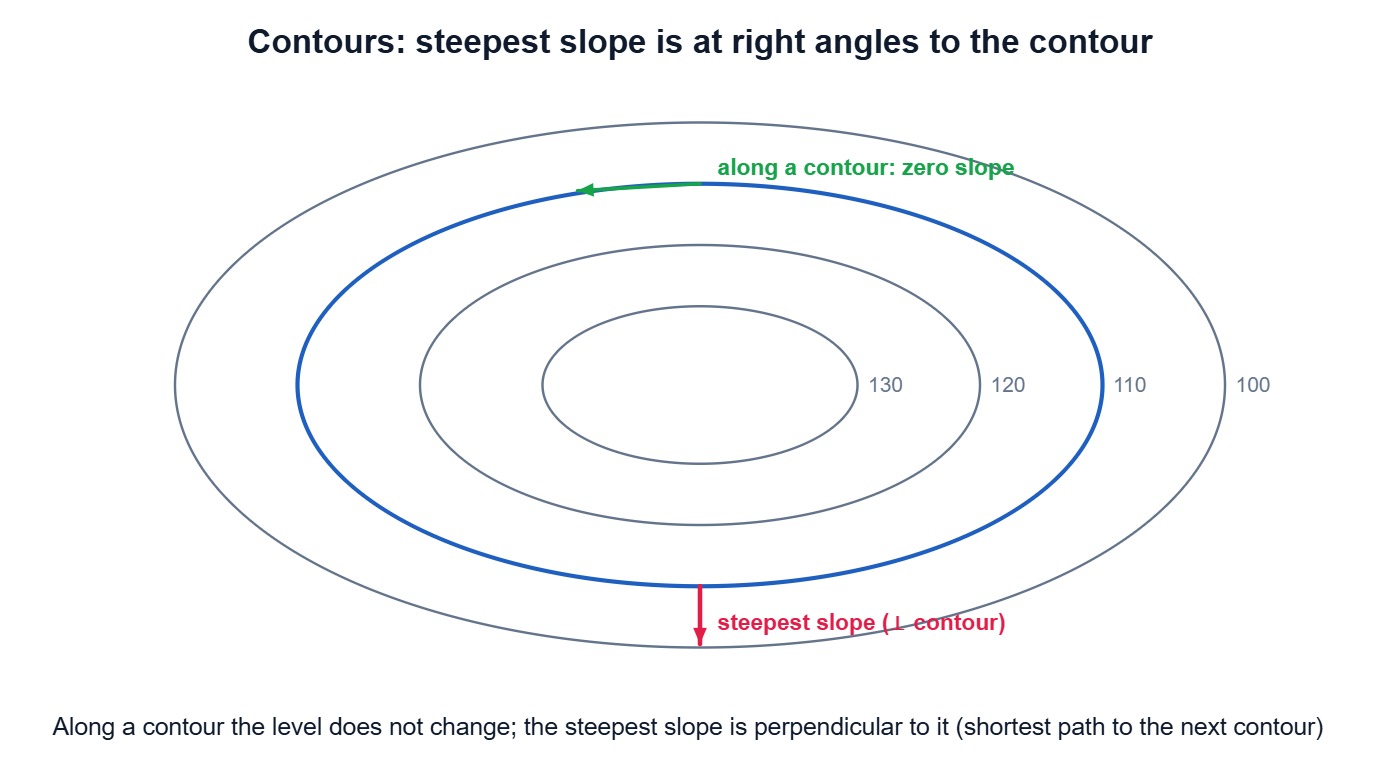
Correct answer: C) At right angles to the contour