What is the theoretical value of effective length of a compression member when it is 'effectively held in position at both ends but not restrained against rotation'?
- A0.50 L
- B0.65 L
- C1.00 LCorrect
- D2.00 L
Solution
Concept
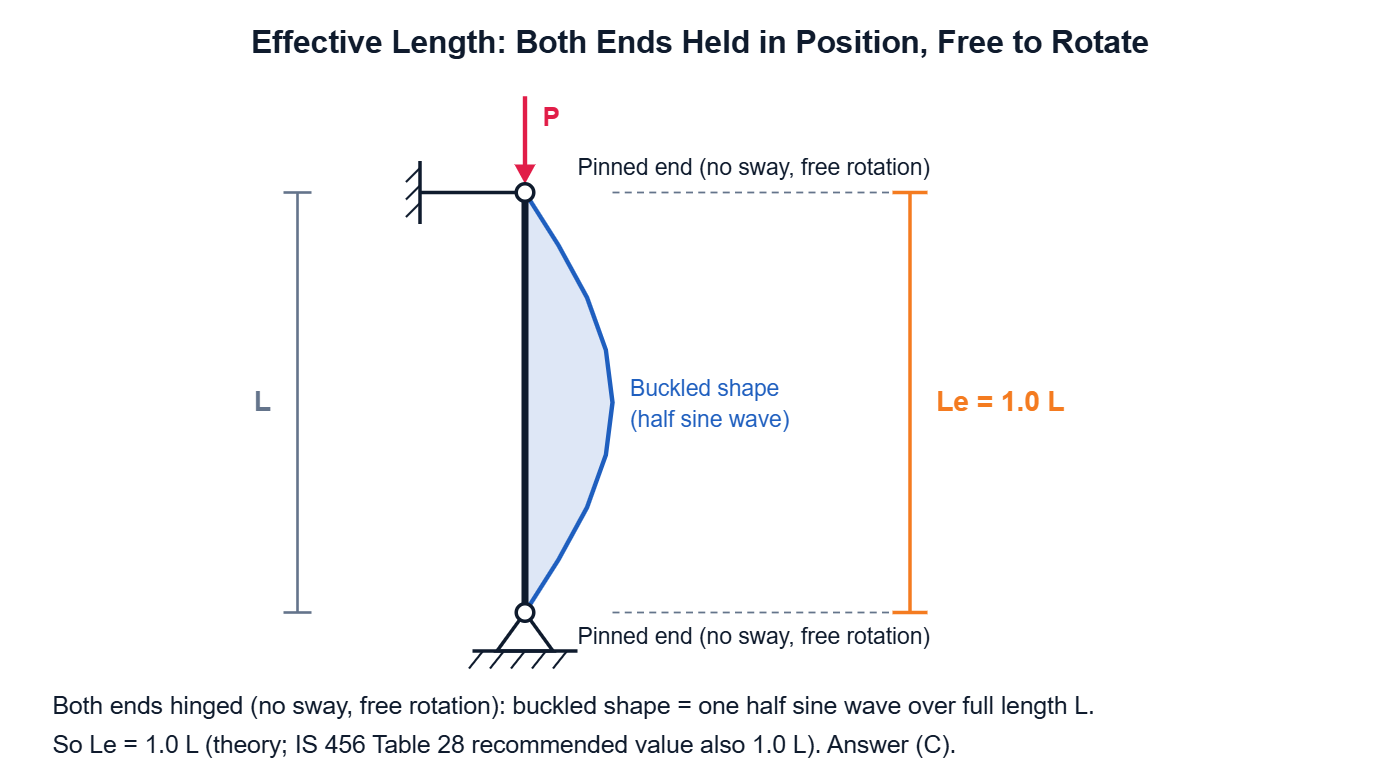
A member held in position at both ends but free to rotate is a pinned-pinned (hinged-hinged) member. Its effective length is equal to its actual length.
Formula
Le = 1.0 L
Step-by-step solution
1. Held in position at both ends means no sideways movement (translation) at either end. 2. Not restrained against rotation means both ends are free to rotate, so both ends are hinged. 3. For a hinged-hinged member, the buckled shape is a half sine wave over the full length. 4. So the theoretical effective length Le = 1.0 L. The recommended value in IS 456 Table 28 is also 1.0 L. 5. Answer is (C).
Explanation
Both ends are held in position and are free to rotate, so the member acts as pinned at both ends. The distance between the points of zero moment is the full length. So the effective length is 1.0 L.
Why the other options are wrong
A: 0.50 L is for both ends fixed (restrained in position and rotation). B: 0.65 L is the recommended (not theoretical) value for both ends fixed. D: 2.00 L is for one end fixed and the other end free (cantilever).
Shortcut
Both ends hinged = 1.0 L. Both fixed = 0.5 L. Fixed-hinged = 0.7 L. Fixed-free = 2.0 L.
Common mistake
Mixing up the theoretical and recommended values, or confusing the hinged case with the fixed case.
Correct answer: C) 1.00 L