Which one of the following is an advantage using a triangular notch over a rectangular notch?
- AVentilation of a triangular notch is necessary
- BThe same triangular notch cannot measure a wide range of flows accurately
- CFor heavy discharges, a triangular notch gives more accurate results than a rectangular notch
- DIn a given triangular notch, only one reading is required to be taken for the measurement of dischargeCorrect
Solution
Concept
A triangular (V) notch needs only one head reading. It needs no ventilation and gives accurate results for small discharges.
Formula
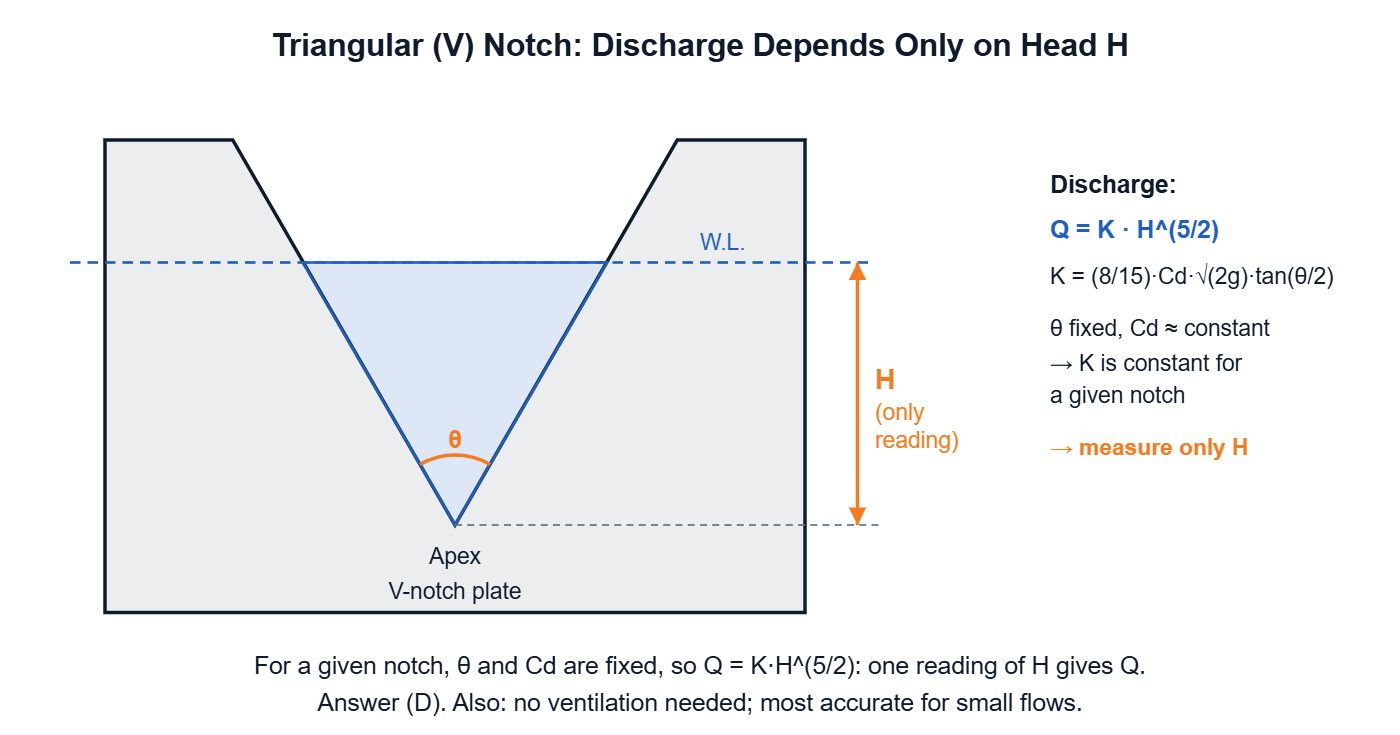
Q = (8/15) × Cd × √(2g) × tan(θ/2) × H5/2
Step-by-step solution
1. Discharge of a triangular notch depends only on head H, because the angle θ is fixed. 2. So for a given notch, only one reading (H) is needed to find Q. 3. Ventilation is not needed in a triangular notch, so A is not an advantage. 4. A V-notch can measure a wide range of flows, so B is false. 5. A V-notch is more accurate for small flows, not heavy flows, so C is false. 6. Correct answer: D
Explanation
The flow shape of a V-notch stays geometrically similar at all heads. So we only need to measure the head H to get the discharge. It also gives accurate results for low flows and does not need ventilation.
Why the other options are wrong
A: A V-notch does not need ventilation, and needing it would be a drawback. B: A V-notch can measure a wide range of flows. C: A V-notch is more accurate for low discharges, not heavy ones.
Shortcut
Remember the V-notch rule: one reading, no ventilation, best for small flows.
Common mistake
Thinking a V-notch is better for large flows. It is actually better for small flows.
Correct answer: D) In a given triangular notch, only one reading is required to be taken for the measurement of discharge